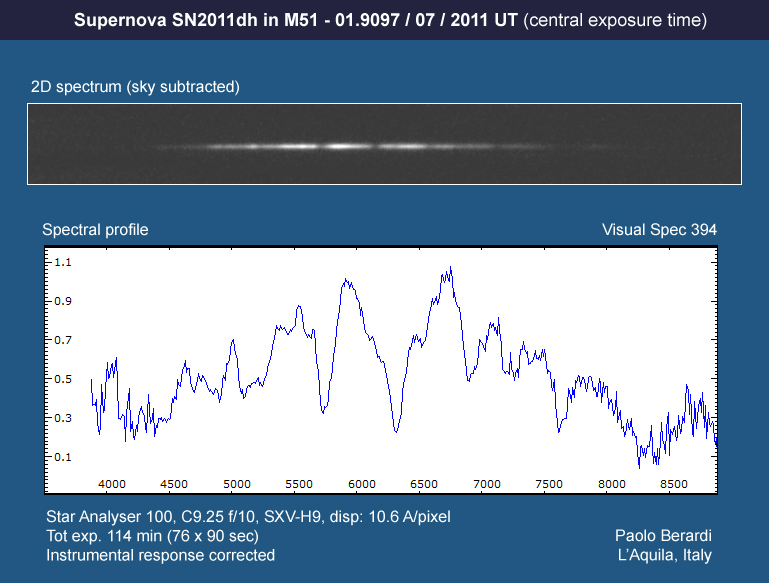
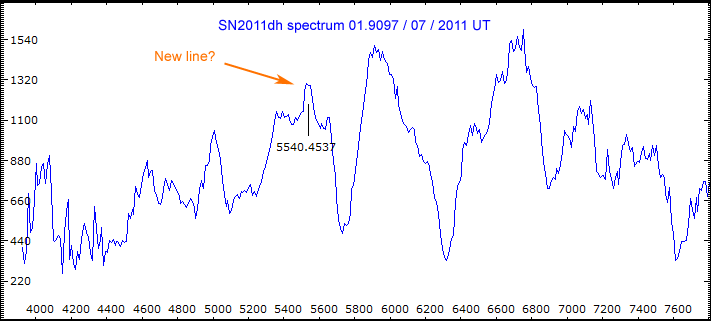
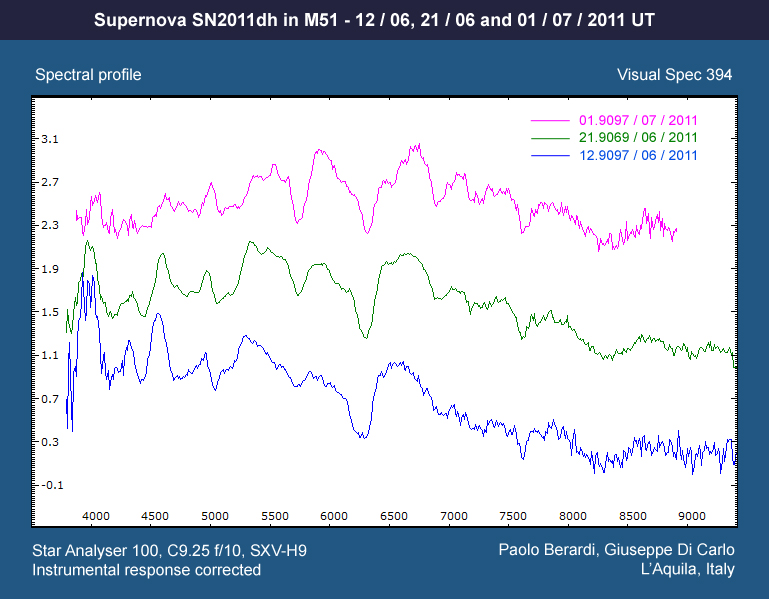
Paolo e Giuseppe,
credo sia opportuno questo cross-post di un messaggio di Christian Buil. Non ho molto tempo a disposizione e scusate se non lo traduco ma sono sicuro che non ci sono problemi per voi. In sostanza dice di continuare ad osservare la SN perchè ci sono grosse possibilità di comparire su articolo scientifici professionali. Poi se c'è qualcosa non chiaro ditemelo.
Marco
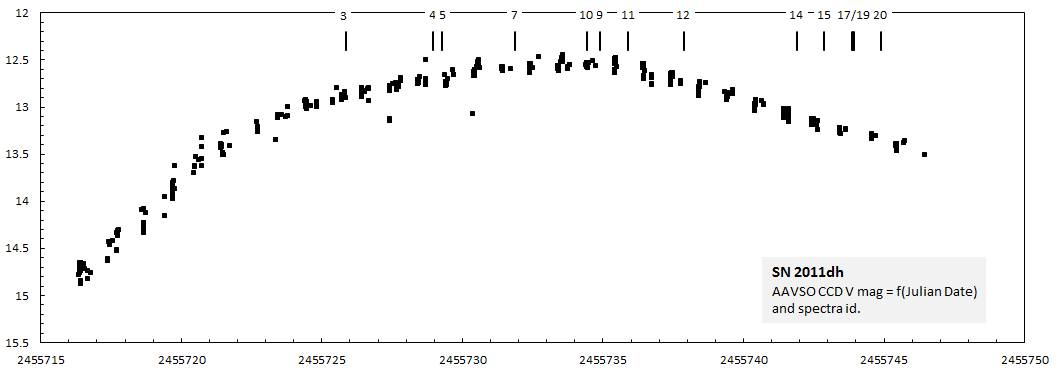
This is an important opportunity for the amateur spectroscopy community. The SN is fading which will make observation even more difficult.
I contacted the principal investigator of this paper
dedicated to SN2011dh:
http://es.arxiv.org/pdf/1106.3551
(a paper which contribution of very well known researchers
in the field).
I have given ARAS page for reference:
http://astrosurf.com/aras/surveys/super ... dh/obs.htm
The return is encouraging and Iair Arcavi leaves hope for a possible contribution of amateurs to next publication in a refereee journal referee. A part of the correspondence about actual ARAS data from Iair:
"....The data quality looks very high, and its timing could make it very useful for us. We'll be working on a second paper with a more
detailed analysis of this supernova and comparison to other events. For such a paper we will need good spectra sampled at regular times, and I think the ones you sent could be very useful for such a study.
..."
The importance also to regroup amateurs observations on a site(here ARAS) and finalize theconstitution and operation an amateur spectral database...
For now,it is more important than ever to observe frequently the object. The redundancy of observationis not a problem here. Given the number of Lhires III 150 t / mm in the wild and also the proliferation of LISA is not right that we have no more observations around the world! This is one of important objects to observe presently. You have the opportunity to attach your name to a professionnal publication.
LISA or Lhires III 150 l/mm are the prefered instrument (all R = 500 - 1000 pectrograph in fact are welcome).The use of SA is not negligible,but avery high quality is required (precise instrumental response, high SNR), which is not simple because the supernova brightness decline.
Fine observations
Christian Buil



 Luna Nuova di Ottobre.